This is the most complete guide to the history of petrol prices in Pakistan available online. We cover every major era from 2006 to 2026, explain what drove prices at each stage, and give you the real numbers behind every significant revision — including the dramatic events of April 2026 that produced the biggest single-day hike in Pakistan’s recorded fuel history, followed by a major relief cut, and the ongoing fortnightly revisions through June 2026.
How Pakistan’s Petrol Pricing System Works
Before tracing the history of petrol prices in Pakistan, it helps to understand how prices are set. The Oil and Gas Regulatory Authority (OGRA) calculates a recommended price every fortnight using a formula based on six components: the international crude cost converted at the prevailing USD/PKR exchange rate, port and import charges, inland freight, oil company margins, dealer commissions, and government taxes. That final number goes to the Prime Minister’s office for approval.
The PM can accept OGRA’s recommendation, reduce it through a petroleum levy cut, or absorb part of it as a subsidy — though since Pakistan’s 2023 IMF agreement, the government’s ability to subsidise fuel indefinitely has been sharply constrained. This formula-driven system means Pakistan petrol price history is really a record of three forces: global oil markets, the Pakistani rupee, and political decisions.
Key formula components (2026 rates):
International crude cost · Port/import charges · Inland freight (IFEM) · OMC margin (~Rs. 7–9/L) · Dealer commission (~Rs. 7.50/L) · Petroleum levy (~Rs. 78/L on petrol as of June 2026) · Sales tax (0% — suspended)
Every $1 change in Brent crude = approximately Rs. 1.50–2.00 per litre at the pump. Every Rs. 1 depreciation of the PKR = approximately Rs. 0.60–0.80 per litre.
The Early Years: 2006–2009 — Stability, Then the First Shock
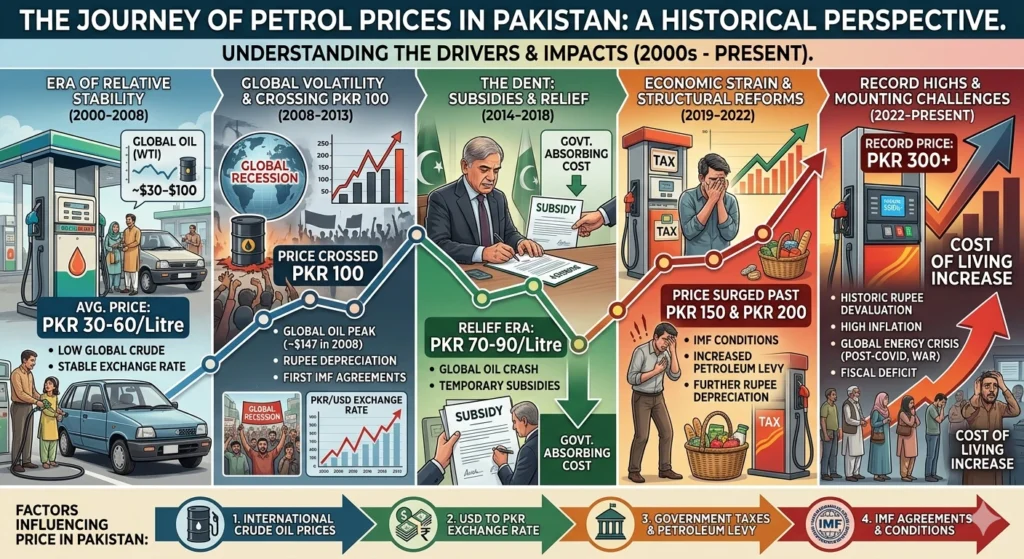
The petrol price history in Pakistan begins in a period of relative calm. In 2006, petrol was a flat Rs. 55.55 per litre for the entire year — a price that seems almost fictional today. The Musharraf government maintained heavy subsidies, insulating consumers from global oil movements. In 2007, prices actually fell slightly to Rs. 51.70 per litre, the lowest level in the modern record.
Then 2008 shattered that calm. Brent crude surged to $147 per barrel — a record that would stand until 2026 — and Pakistan could no longer afford its subsidy bill. Prices climbed month by month, from Rs. 53.70 in January to Rs. 86.66 in August 2008. It was Pakistan’s first real taste of international oil volatility, and it set the template for everything that followed: a period of artificially held prices, followed by a sudden, painful correction.
Average petrol price: Rs. 58.70/L · Range: Rs. 51.70 – Rs. 86.66 · Defining event: Global crude hits $147/barrel in 2008
The Rising Decade: 2010–2014 — Steady Climb to Rs. 112
The history of petrol prices in Pakistan through the 2010–2014 period shows a slow but consistent upward march. Crude oil stabilised in a $90–110 range globally, and Pakistan’s PKR was relatively stable. Prices climbed from Rs. 65 in early 2010 to Rs. 112.76 by early 2014 — driven less by sudden shocks and more by the gradual removal of subsidies and the creeping increase in government levies.
The second half of 2014 brought unexpected relief: Saudi Arabia opened the taps to defend market share, and global crude crashed from over $100 to below $60 per barrel within months. By December 2014, petrol in Pakistan had fallen to Rs. 84.53, and the downward trend would continue into 2015 and 2016.
Average petrol price: Rs. 93.50/L · Range: Rs. 65.11 – Rs. 112.76 · Defining event: Global crude crash (late 2014)
The Stable Era: 2015–2019 — Four Years Under Rs. 120
For those looking at the Pakistan petrol price history with nostalgia, 2015–2019 represents the most affordable sustained period in the modern era. Crude stayed low, the rupee held relatively steady, and prices stayed in the Rs. 62–118 range for nearly five years. In 2016, petrol briefly dipped to Rs. 62.77 per litre in March — the second-lowest price of the decade.
This era also saw the beginning of a pattern that would repeat: OGRA recommending price reductions that the government accepted in full, passing relief directly to consumers. The PTI government that took power in 2018 inherited this favourable environment, though by 2019 prices were already climbing again as crude recovered and the rupee came under pressure.
Average petrol price: Rs. 85.40/L · Range: Rs. 62.77 – Rs. 117.83 · Defining event: Longest affordable period in modern history
Pandemic and Shock: 2020–2022 — From Record Low to Record High
No period in the history of petrol prices in Pakistan saw a wider swing than 2020–2022. COVID-19 collapsed global oil demand in 2020, and Brent briefly went negative in international markets. Pakistan’s petrol price hit a multi-decade low of Rs. 74.52 per litre in June 2020. Consumers who remember filling up for under Rs. 75 in the summer of 2020 were in for a rude awakening.
The rebound was ferocious. By early 2022, petrol was at Rs. 147.83 — already painful. Then came the political crisis of April–May 2022. The PTI government was removed, and the incoming coalition immediately faced an impossible choice: remove the massive fuel subsidy the outgoing government had put in place, or continue haemorrhaging billions from the national exchequer. They chose to remove it. On May 26, 2022, petrol jumped to Rs. 179.86 overnight. Three weeks later it crossed Rs. 200 for the first time in Pakistan’s history.
By June 2022, Pakistan was at Rs. 233.89 per litre. The petrol price history of Pakistan had been rewritten entirely within a single month.
Average petrol price: Rs. 174.60/L · Range: Rs. 74.52 – Rs. 233.89 · Defining event: COVID collapse then subsidy removal in May 2022
2023 — The Year of the Historic Peak
If 2022 was the year Pakistan crossed Rs. 200, then 2023 was the year it crossed Rs. 300. The combination of a rupee that lost over 40% of its value against the dollar in a single year, IMF conditions that ruled out fuel subsidies, and continued global crude pressure pushed petrol to Rs. 282.00 in April 2023.
By September 2023, Pakistan reached Rs. 323.38 per litre — the highest sustained petrol price in the country’s recorded history at the time. This was the all-time peak for an extended period. A kilogram of tomatoes cost less than half a litre of petrol. The year 2023 sits permanently near the top of any honest history of petrol prices in Pakistan as among the cruelest for ordinary consumers — until April 2026 rewrote those records entirely.
| Period | Key Rate | Avg Price | What Happened |
|---|---|---|---|
| 2006–2007 | Rs. 51.70 – 55.55 | Rs. 54 | Govt subsidies, stable crude |
| 2008 | Rs. 53.70 → 86.66 | Rs. 72 | Crude hits $147 — first major shock ▲ |
| 2009–2010 | Rs. 56 – 73 | Rs. 63 | Post-crash recovery, partial relief ▼ |
| 2011–2014 | Rs. 73 → 112.76 | Rs. 96 | Gradual subsidy removal, levy increases ▲ |
| 2015–2019 | Rs. 62.77 – 117.83 | Rs. 85 | Longest affordable era in modern history ▼ |
| Jun 2020 | Rs. 74.52 | — | COVID demand collapse — decade low ▼ |
| May 2022 | Rs. 179.86 | — | Coalition removes subsidy overnight ▲ |
| Jun 2022 | Rs. 209.86 | — | First time above Rs. 200 in history ▲ |
| Sep 2023 | Rs. 323.38 | — | Rupee crash + crude surge — prior peak ▲ |
| 2024–2025 | Rs. 247 – 293 | Rs. 267 | Gradual correction as crude eases ▼ |
| Mar 7, 2026 | Rs. 321.17 | — | Iran war — Rs. 55 emergency hike ▲ |
| Apr 3, 2026 | Rs. 458.41 | — | Biggest single hike ever: +Rs. 137.24 ▲ |
| Apr 11, 2026 | Rs. 366.58 | — | PM cuts levy Rs. 80 — major relief ▼ |
| Apr 25, 2026 | Rs. 393.35 | — | Fortnightly hike +Rs. 26.77 as crude held high ▲ |
| May 9, 2026 | Rs. 414.78 | — | Weekly hike +Rs. 14.92 on crude pressure ▲ |
| May 16, 2026 | Rs. 409.78 | — | Mid-month relief cut −Rs. 5.00 ▼ |
| Oct 6, 2026 | Rs. 393.64 | — | Latest notified petrol rate — current rate ▲ |
2024–2025 — The Correction That Never Fully Arrived
After the Rs. 323.38 peak of September 2023, Pakistan entered a period of gradual price correction. Global crude softened, the rupee stabilised, and OGRA passed modest reductions in each fortnightly review. By October 2024, petrol had come down to Rs. 247.03 — a meaningful reduction of over Rs. 76 per litre from the 2023 peak.
Throughout 2025, prices hovered in the Rs. 252–270 range. To anyone studying the petrol price history of Pakistan over the long arc, this looked like a plateau: relief from the worst of 2023, but nowhere near the pre-2022 levels that Pakistanis had considered normal. By December 2025, petrol sat at Rs. 263.45 — expensive by historical standards but stable.
Average petrol price: Rs. 264/L · Range: Rs. 247.03 – Rs. 293.94 · Defining event: Gradual correction after 2023 peak, but prices never returned to pre-2022 levels
2026 — An Exceptionally Volatile Year
Pakistan’s 2026 petrol history has been unusually volatile. The year included a record peak of Rs. 458.41 per litre on 3 April, followed by sharp reductions and then a return to frequent notified revisions during late summer and early autumn.
From the Rs. 337.78 rate notified on 21 August, petrol moved through a sequence of daily or short-period adjustments. It reached Rs. 393.75 on 22 September, eased to Rs. 387.40 on 1 October, and was then notified at Rs. 393.64 per litre on 6 October 2026.
2026 recorded range: Rs. 253.17 – Rs. 458.41/L · Latest notified rate: Rs. 393.64/L · This interactive log records each available notified price change.
Why the History of Petrol Prices in Pakistan Matters
Petrol prices are not just a number on a forecourt board. Every revision in Pakistan’s fuel price history sends ripples through the entire economy. Transport fares rise within days of any hike. Food prices follow within weeks, as everything from wheat flour to vegetables travels by road. Manufacturers face higher input costs. The State Bank watches inflation data with dread every time OGRA issues a new notification.
Motorcycles are Pakistan’s most common personal vehicle — there are over 25 million registered. For a daily-wage worker riding 30 km to work and back, the difference between Rs. 74 per litre (June 2020) and Rs. 393.64 per litre (October 2026) is not an abstraction. It is the difference between keeping a household financially functional and sliding into debt. The history of Pakistan petrol prices is, at its core, a social history.
Understanding this history also helps Pakistanis make better financial decisions. Households that understand how global crude prices, the PKR exchange rate, and government levy policies interact are better positioned to anticipate future revisions — and calculate what each price change actually costs them in monthly fuel spending.
What Drives Pakistan’s Petrol Price: A Quick Reference
Global crude oil price — The single biggest driver. Pakistan uses Arab Gulf benchmark pricing. Each $1/barrel change moves the pump price by approximately Rs. 1.50–2.00/L.
USD/PKR exchange rate — Pakistan pays for oil in dollars. Each Rs. 1 depreciation adds Rs. 0.60–0.80/L even if crude prices are unchanged.
Petroleum levy — A fixed-per-litre government tax. As of June 2026 the levy is approximately Rs. 78/L on petrol. After the April 3 hike it reportedly rose to Rs. 160/L before the PM cut it by Rs. 80. The levy is a key IMF revenue floor and cannot easily be reduced below a minimum threshold.
Sales tax / GST — Currently 0% on petrol — suspended since 2022 under IMF agreement pressure.
PM’s office decision — OGRA recommends; the PM approves, modifies, or rejects. Political decisions frequently override the formula — as happened on April 3–11, 2026.
For a step-by-step breakdown of the exact OGRA formula used to calculate each revision, see our guide: How Is Petrol Price Calculated in Pakistan?
Frequently Asked Questions
The history of petrol prices in Pakistan is a record of a country perpetually caught between global forces it cannot control and domestic pressures it can never fully absorb. From Rs. 55 in 2006 to Rs. 393.64 in October 2026 — by way of a harrowing Rs. 458.41 peak in April — the journey has redrawn household budgets, reshaped supply chains, and placed an enormous burden on millions of Pakistanis who depend on affordable fuel to earn a living.
Prices will continue to change. Brent crude is stabilising but the Middle East situation remains unresolved, the PKR remains vulnerable to external shocks, and the petroleum levy remains a key revenue tool for a government under IMF pressure. Future revision dates depend on the applicable notification cycle. Bookmark PakistanPetrolPrices.com to stay updated every time OGRA issues a new notification.