The Diesel Pump Price Just Fell by Rs 32. But the Dealers’ Share of It Is Quietly Going Up
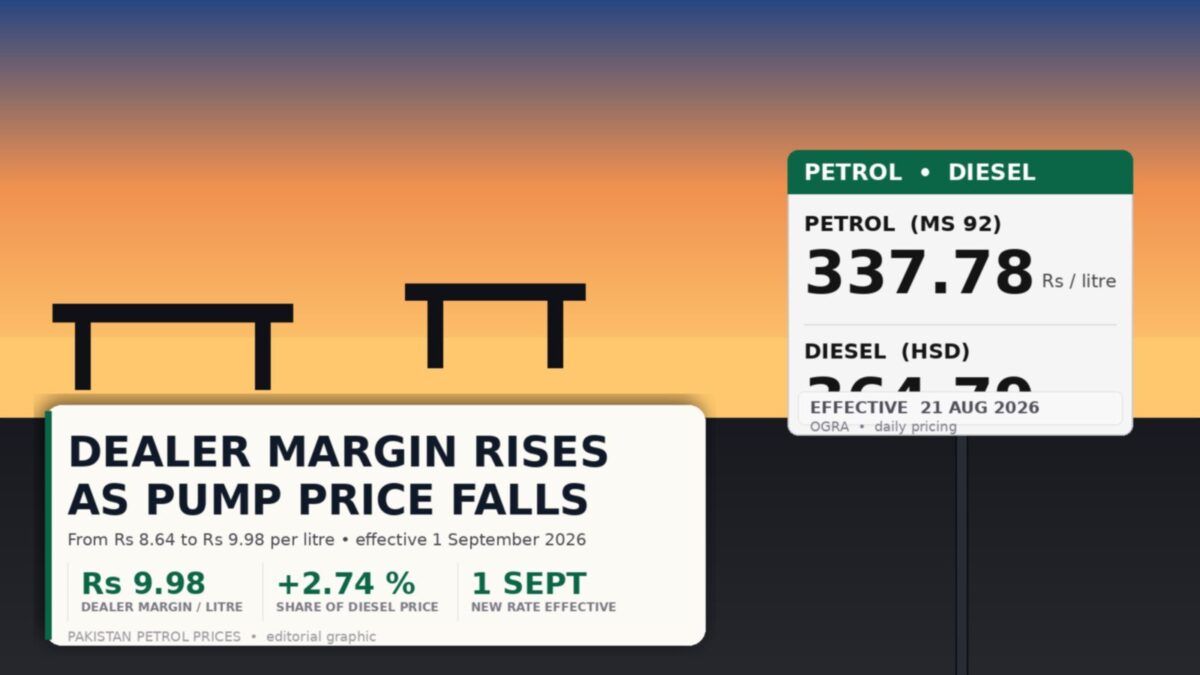
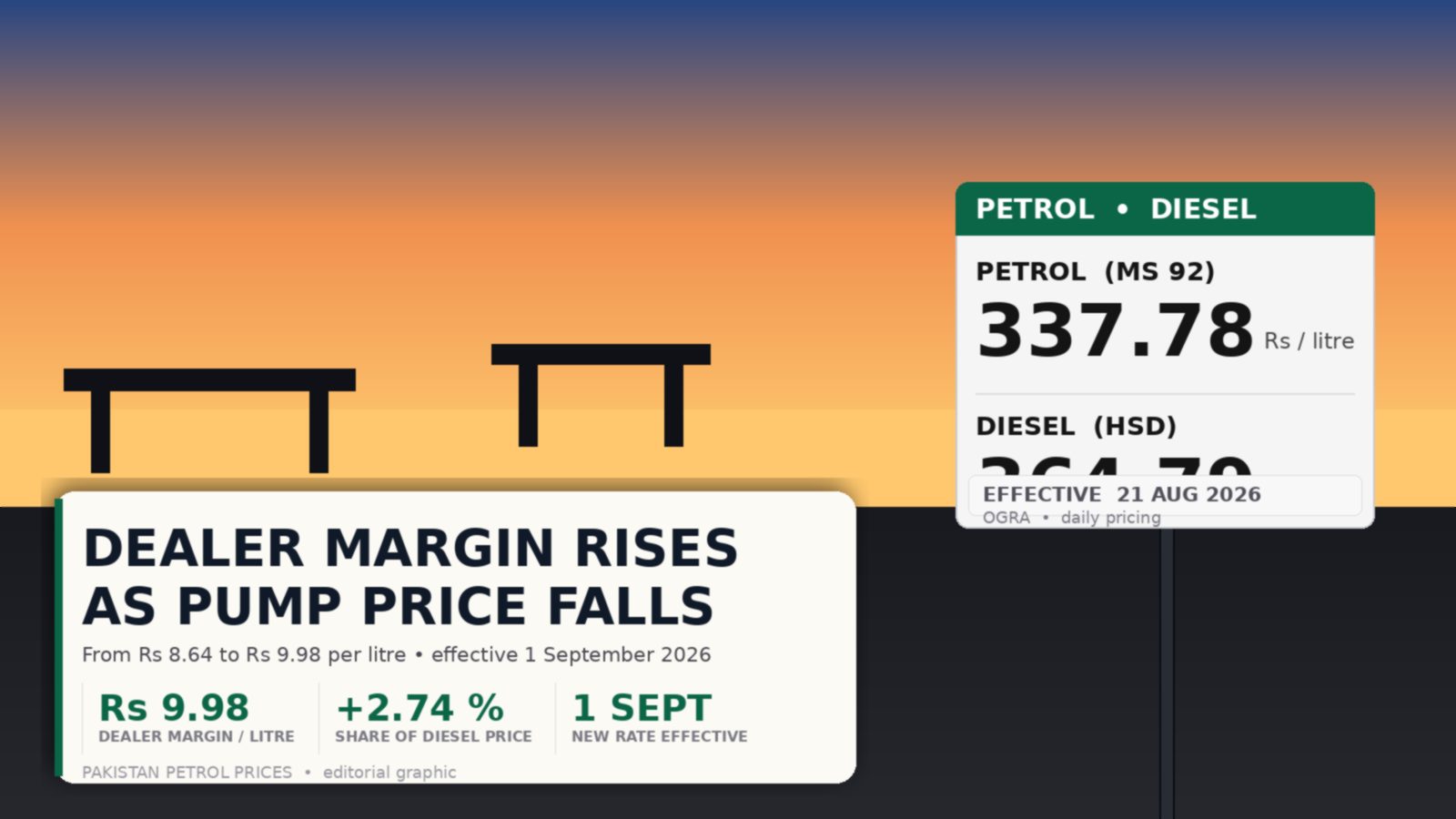
The Economic Coordination Committee approved a hike in the petroleum dealers’ margin from Rs 8.64 to Rs 9.98 a litre back in August. The new rate only kicks in from 1 September 2026. With diesel now trading at Rs 364.79 a litre instead of Rs 395.69, the dealers’ slice of the new lower price is 2.74%, up from 2.52% before the cut. Here is what changes on 1 September, what stays the same, and what it means for your next fill-up.
The numbers in plain English
The petroleum dealer’s margin is the slice of the pump price that the petrol station owner keeps. It is set by the government, not by the market. Until 31 August 2026, that slice is Rs 8.64 per litre on every litre of petrol and every litre of high-speed diesel that leaves the pump. From 1 September 2026, it becomes Rs 9.98 per litre, an increase of Rs 1.34 or 15.5%.
The increase was approved by the Economic Coordination Committee of the federal cabinet on 14 August 2026 and signed off by the Prime Minister, ending a 72-hour ultimatum that would otherwise have closed pumps nationwide from 6am on 15 August. The original story of the deal is in our 15 August coverage of the strike call-off.
Why the share is going up even though the price is going down
This is the part of the story that matters for a household filling a tank, and it is what the new margin does to the structure of the price. The dealers’ margin is a fixed rupee number on top of every litre, not a percentage. So when the headline price falls, the dealers’ share of it rises, mechanically.
Take diesel, which is the larger of the two products by volume. Before the 20 August cut, diesel was at Rs 395.69 a litre. Rs 8.64 of that was the dealer’s cut, which worked out to 2.18% of the pump price. After the cut, diesel is at Rs 364.79 a litre. The dealers’ cut is still Rs 8.64 a litre for the next 11 days, then Rs 9.98 a litre from 1 September.
That is a 2.74% share at the new price, up from 2.52% before. The dealer is not charging any more, but the dealer’s share of the new, lower price is bigger. It is a small structural change that is invisible in the headlines and visible only in the maths.
What changes for the consumer on 1 September
Strictly speaking, the dealer margin increase adds Rs 1.34 to the ex-depot price of both petrol and diesel from 1 September. Whether that full Rs 1.34 shows up at the pump depends on what the government does with the other layers of the price, particularly the petroleum levy.
The petroleum levy is the largest single tax on fuel and the only part of the price the government can trim to absorb the change. The current rate on petrol is Rs 78.30 a litre and on diesel is Rs 78.30 a litre. If the government does nothing else, the pump price on 1 September should be Rs 1.34 higher than the rate on 31 August for both fuels, before accounting for the next daily revision.
For most households, Rs 1.34 on a litre of fuel is below the noise floor of the daily pricing cycle. On a 40-litre fill, that is Rs 53.60. On a month’s worth of fuel for a small car, that is a few hundred rupees. It is a real cost, but it is the smallest of the moving parts in the fuel price. The bigger question is whether the government chooses to use the petroleum levy to absorb it.
What stays exactly the same
The structure of the price does not change. The dealer margin is one slice of a multi-layer price stack that also includes the refinery or import price, the petroleum levy, customs duty, the climate support levy, the inland freight equalisation margin, and the oil marketing company’s margin. None of those other layers change as a result of the 14 August decision. The change is only on the dealer line.
Daily pricing continues. The dealer’s new Rs 9.98 is added on top of whatever the rest of the price stack happens to be on the day, and that day-by-day price is what you pay at the pump. The move to a daily mechanism earlier in the year is not affected by the margin decision.
Where the dealer margin sits in the price stack
A useful way to think about the Rs 9.98 is to compare it to the other components. The petroleum levy is currently Rs 78.30 on both petrol and diesel, more than seven times the dealer’s cut. Customs duty adds another Rs 15.68 on diesel. The climate support levy adds Rs 5. The inland freight equalisation margin is in single digits. The OMC margin is Rs 7.87 a litre.
So the dealer is the smallest paid participant in the fuel supply chain. They take the risk of holding stock, the cost of running the pump, and the credit risk on customers. The Rs 9.98 is the floor of the entire structure. Everything else is bigger, and most of it goes to the government in tax.
The bigger picture
The 14 August decision was the first time the dealer margin had been revised upward in several years. The Petroleum Dealers Association had argued that the Rs 8.64 was no longer enough to cover operating costs, and the ECC’s approval of a 15.5% increase reflects a reluctant agreement with that argument. The industry says the Rs 9.98 brings the margin closer to a sustainable level, although the association had originally asked for an 8% increase and ultimately accepted 15.5%, which is closer to double the ask in percentage terms but on a different base.
For the next 11 days, the rate you pay at the pump will continue to reflect the old Rs 8.64 margin. From 1 September, the same litre of fuel will quietly include the new Rs 9.98. The change is small enough that most consumers will not notice it on a single fill-up, but it is the structural piece of the price that the government has chosen to raise, rather than absorbing through the petroleum levy or the customs duty.
That is the choice worth watching over the next ten days. If the government uses the petroleum levy to offset the increase on 1 September, the headline pump price will not change and the dealers’ share of the new, lower price will rise. If the government does nothing, the pump price will go up by Rs 1.34, and the dealers’ share of the new, lower price will still rise, just on a slightly higher base.
What people are asking
When does the new dealer margin of Rs 9.98 take effect?
From 1 September 2026. Until 31 August 2026, the dealer margin remains at Rs 8.64 per litre on both petrol and high-speed diesel.
Will the pump price go up on 1 September?
The dealer margin increase of Rs 1.34 a litre adds to the ex-depot price from 1 September. Whether the full Rs 1.34 shows up at the pump depends on whether the government absorbs it through the petroleum levy. If the government does nothing, the pump price will be Rs 1.34 higher on 1 September than on 31 August, before any other daily revision.
Is the Rs 9.98 margin on both petrol and diesel?
Yes. The Economic Coordination Committee approved a 15.5% increase in the dealer margin on both motor spirit (petrol) and high-speed diesel. The same Rs 9.98 applies to both products from 1 September 2026.
How much more will a typical fill-up cost?
On a 40-litre tank, the increase is Rs 53.60 if the full Rs 1.34 is passed through. The exact cost depends on the size of your tank, how often you fill, and whether the government absorbs part of the increase through the petroleum levy.
Why is the share of the pump price going up if the headline rate is going down?
The dealer margin is a fixed rupee number, not a percentage. When the headline pump price falls, the same fixed rupee becomes a bigger share of the new lower price. The dealer’s share of the diesel price rises from about 2.52% before the cut to about 2.74% after.
What is the dealer margin compared to the petroleum levy?
The petroleum levy is Rs 78.30 a litre on both fuels, more than seven times the dealer margin. Customs duty adds another Rs 15.68 a litre on diesel, and the climate support levy adds Rs 5. The dealer is the smallest paid participant in the fuel supply chain.
Is this the first time the dealer margin has been revised?
The 14 August decision was the first revision in several years. The Petroleum Dealers Association had argued that the Rs 8.64 rate was no longer enough to cover operating costs.
Does daily pricing still apply?
Yes. The dealer’s new Rs 9.98 is added to the daily-reviewed ex-depot price, and the result is what you pay at the pump. The move to a daily mechanism earlier in the year is not affected by the margin decision.