Petrol Price in Pakistan Before Iran War: What It Was, Why It Mattered, and What Changed
For years Pakistan’s fuel prices sat on a knife-edge — low enough to keep motorcyclists and rickshaw drivers afloat, high enough to keep OGRA budgets in the red. Then the shadow of the Iran conflict fell across the Strait of Hormuz, and the arithmetic changed for everyone.
There is a number that every Pakistani knows without looking it up. It lives on the signboard outside the PSO pump at the corner of every busy road, on the WhatsApp forwards that arrive the moment OGRA makes an announcement, on the lips of every auto-rickshaw driver haggling over a fare. That number is the petrol price — and in the months before escalating tensions between Iran and its neighbours began to reshape the regional energy picture, that number told a particular story about Pakistan’s place in the global oil economy.
This article reconstructs that story in detail. It examines what the petrol price in Pakistan before the Iran war actually was, why it reached those levels, how the pricing mechanism works, and what the subsequent conflict’s shadow over the Persian Gulf has meant for Pakistani motorists, transporters, and the millions of people whose livelihoods depend on the cost of a litre of fuel.
1. What petrol actually cost before the conflict
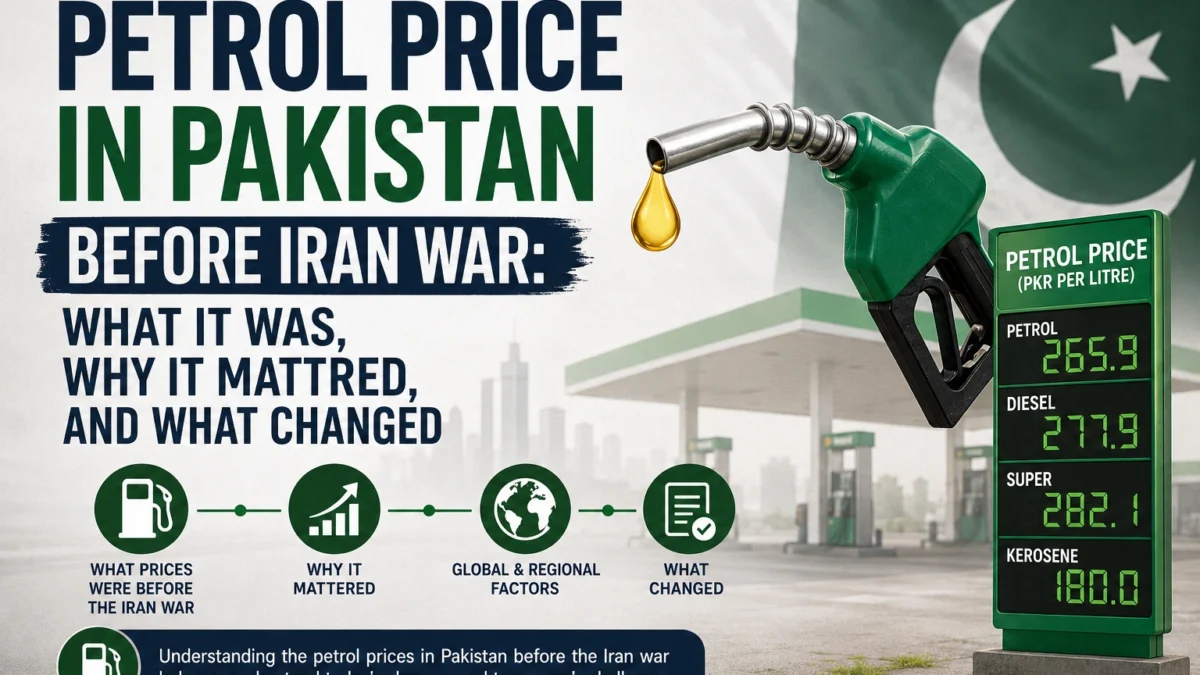
In the fortnight that preceded the most recent round of Iran-linked tensions, OGRA — the Oil and Gas Regulatory Authority — had notified fuel rates that reflected a period of relative calm in global crude markets. The rate for Motor Spirit (RON 92), the grade Pakistanis call “petrol” and which powers the country’s overwhelming majority of motorcycles, cars, and auto-rickshaws, stood at a level that, by the standards of Pakistan’s own recent history, was neither at crisis highs nor at the subsidy-inflated lows of earlier eras.
High-Speed Diesel (HSD): Rs 256.91 per litre
Kerosene Oil: Rs 183.56 per litre
Light Diesel Oil (LDO): Rs 171.44 per litre
These were the last OGRA-notified rates before the regional situation materially altered crude futures.
To understand whether those figures represent hardship or relief, it helps to set them against the trajectory that preceded them. Pakistan had been through a punishing period of currency-driven fuel price inflation in 2022 and 2023, when a collapsing rupee combined with the post-Ukraine spike in Brent crude to push petrol past Rs 330 per litre. The gradual easing back toward the Rs 240–260 range felt, to many consumers, like genuine relief — even if it still represented a near-doubling compared to prices a decade earlier.
| Period | Petrol (Rs/litre) | HSD (Rs/litre) | Context |
|---|---|---|---|
| June 2022 | 209.86 | 204.15 | Post-Ukraine supply shock |
| Sep 2022 | 224.80 | 235.30 | Rupee depreciation accelerating |
| Feb 2023 | 272.95 | 280.10 | IMF programme conditions; subsidy removal |
| June 2023 | 305.00 | 311.84 | Peak — currency crisis + Brent above $75 |
| Dec 2023 | 281.57 | 290.83 | Partial stabilisation |
| June 2024 | 262.00 | 268.22 | Rupee recovery; Aramco CP easing |
| June 2025 | 248.17 | 256.91 | Last pre-escalation notification |
The Rs 248.17 figure is therefore not an aberration — it is the product of several converging factors: a more stable rupee sitting in the Rs 278–282 range against the dollar, Saudi Aramco’s Contract Price (CP) for Arab Light crude remaining contained, and a global demand picture that, heading into mid-2025, had not yet fully priced in a Persian Gulf risk premium.
2. How OGRA sets the price — and why it matters
Most Pakistanis know that the petrol price changes on the first and sixteenth of every month. Fewer know precisely why those particular dates, or how the number on the pump sign is arrived at. The mechanism matters, because it is exactly this mechanism — its inputs and its assumptions — that makes Pakistan’s fuel market so sensitive to anything that happens near the Persian Gulf.
OGRA’s pricing formula is not a mystery. It is published and follows a broadly transparent methodology that traces its structure back to the deregulation agreements of the early 2000s. The ex-refinery price — what the oil company charges before distribution — is pegged to import parity, which means it is calculated as if the product were being imported, regardless of whether a particular litre actually was. This import parity price is then built up with:
- Petroleum Levy (a government charge, currently maxed at Rs 78 per litre for petrol)
- General Sales Tax (GST) — where applicable, as GST on fuel has been a political lever in recent budgets
- Inland freight equalization margin (IFEM)
- Oil Marketing Company (OMC) margin
- Dealer commission
The Petroleum Levy alone — Rs 78 per litre by mid-2025 — represents roughly 31% of the ex-pump price for petrol. It is a significant source of government revenue, accounting for hundreds of billions of rupees annually, and it is also why Pakistani governments face such painful choices when crude prices rise: absorbing the shock means surrendering that revenue, while passing it on means political crisis.
“At Rs 248 per litre, the government was collecting more in levy per litre than many Pakistani households earn per hour. The pump price was, in part, a fiscal instrument.”
For a deeper look at how OGRA arrives at current and historical prices, see our complete Pakistan petrol price history page, which tracks every fortnightly notification going back several years.
3. The Saudi Aramco link: Pakistan’s oil lifeline
Pakistan does not set its fuel prices in isolation. The country imports the majority of its petroleum, and a substantial portion of that comes from Saudi Arabia — which means the Saudi Aramco Contract Price (CP) for Arab Light crude is among the most closely watched numbers in Islamabad’s energy planning circles.
The CP is announced by Saudi Aramco monthly, denominated in dollars per barrel, and serves as the effective benchmark for what Pakistan State Oil (PSO) and other importers pay for their crude. In the months leading up to the regional escalation, the CP had been moving in a range that, while not cheap, had retreated from the highs of 2022. Arab Light for April, May, and June 2025 deliveries had sat between $86 and $89 per barrel — elevated by historical standards but manageable given the rupee’s relative stability.
For context on how Aramco’s pricing has shaped Pakistani pump rates over time, our Aramco Contract Price analysis article walks through the mathematical relationship between the CP, the rupee-dollar exchange rate, and what ultimately appears on OGRA’s notification.
The critical vulnerability is not the price itself but the currency. Every one-rupee depreciation against the dollar adds roughly Rs 0.40–0.50 to the ex-refinery price of petrol — a small-sounding number that, across Pakistan’s daily consumption of several million litres, translates into hundreds of millions of rupees in additional import costs monthly. It is this combination — dollar-denominated oil, a rupee that has historically trended weaker, and a government that must extract levy revenue from every litre — that makes the Pakistan fuel market structurally exposed to external shocks.
4. Iran, the Strait of Hormuz, and Pakistan’s exposure
To understand why a conflict involving Iran has such direct bearing on the petrol price in Pakistan, it is worth considering the geography of the oil trade in the region.
The Strait of Hormuz, the narrow waterway between Iran and Oman at the mouth of the Persian Gulf, is the most significant chokepoint in global energy logistics. Approximately one-fifth of the world’s traded oil — and an even higher proportion of the liquefied natural gas (LNG) shipped to Asia — passes through those 21 nautical miles at the strait’s narrowest. When anything threatens the freedom of navigation through Hormuz, the entire oil futures market reacts.
Pakistan’s exposure operates at two levels. The first is direct: Pakistani oil imports, primarily from Saudi Arabia, the UAE, and Kuwait, travel through or near the Persian Gulf. Any disruption to tanker traffic in those waters would directly affect delivery timelines and insurance premiums — costs that feed back into the ex-refinery price within weeks. The second is indirect but more immediately felt: even before a single tanker is delayed, the threat of conflict drives up Brent crude futures, which in turn raises the import parity calculation that OGRA uses to set pump prices.
The journey from Saudi Arabian terminals to Karachi port typically takes 5–8 days through the Gulf of Oman.
Every $5 per barrel rise in Brent crude adds approximately Rs 3–4 to Pakistan’s ex-refinery petrol price, before taxes.
Pakistan also shares an 813-kilometre border with Iran — a fact that has historically created opportunities for cross-border fuel smuggling when the differential between Iranian (heavily subsidised) and Pakistani pump prices has been large. The Iran-Pakistan relationship on the energy front is thus simultaneously a vulnerability (supply chain exposure) and, informally, a partial price relief mechanism through illicit border trade that Pakistani authorities have rarely managed to suppress entirely.
5. How prices shifted once tensions escalated
The months following the initial escalation of Iran-linked tensions illustrated with uncomfortable precision just how quickly the Pakistani fuel market can be repriced by events far beyond the country’s control.
Brent crude, which had been trading in a broadly contained range through the first half of 2025, spiked as markets began to price in a Hormuz risk premium. The move was not immediate — oil markets often require several days of sustained newsflow before the futures curve shifts materially — but within a fortnight of the first serious military exchanges in the region, the premium had appeared. The rupee, which tends to weaken when global risk appetite deteriorates and dollar demand rises, added a second layer of pressure.
OGRA’s fortnightly notification mechanism meant that the full impact of the crude spike took roughly two to four weeks to appear on petrol pump signboards — but when it did, it arrived in a single, visible adjustment that landed on consumers as a tangible shock. The gap between what petrol cost before the escalation and what it cost after represents, in rupee terms, a significant new burden on every Pakistani who fills a tank, carries goods, or takes public transport.
For the most current notified rates, see our live Pakistan petrol price page, which is updated every time OGRA issues a new notification.
6. Who really pays: the burden on ordinary Pakistanis
Discussions of petrol prices in Pakistan often frame the issue in macroeconomic terms — current account deficits, foreign exchange reserves, IMF programme conditions. These framings are not wrong, but they can obscure the human stakes of fuel pricing in a country where the majority of households have no car and still feel the price at the pump acutely.
The mechanism is inflation. Diesel — whose price in Pakistan has historically tracked even higher than petrol — is the fuel of the transport network. When High-Speed Diesel costs more, it costs more to move wheat from a farm in Punjab to a flour mill in Lahore, more to ship a container of garments from a factory to the port, more to run the buses and trucks that carry goods and people across a country with limited rail freight. That cost does not stop with the transporter. It moves through the supply chain and arrives, eventually, as a higher price for atta, for vegetables, for medicine, for everything that comes off a truck.
The households least able to absorb that inflation are precisely those most dependent on it — the wage-earner buying daily provisions at a market stall, the tenant farmer whose fertiliser and pesticide must be transported to him, the factory worker whose commute costs rise with the rickshaw fare. Pakistan’s BISP social protection scheme and various government relief measures have attempted to offset some of this pressure, but the architecture of the fuel pricing system — in which a substantial levy is baked into every litre — means that relief at the pump is simultaneously a reduction in government revenue, and therefore in the fiscal space available for spending on the people fuel price rises hurt most.
“A one-rupee increase in petrol costs a motorcycle-taxi driver perhaps Rs 15 extra per day. Over a month, that is Rs 450 — nearly the cost of a week’s cooking oil for a family of five.”
The diesel dimension
It is worth noting that the civilian media focus on petrol — the motorcycle and car fuel — sometimes obscures the fact that diesel is a more economically consequential fuel for Pakistan’s broader cost of living. HSD powers agriculture (tubewells, tractors, threshers), long-haul freight, the bus network, and electricity generation via captive generators in the country’s vast informal industrial sector. For our detailed breakdown of how diesel pricing works in Pakistan and how it tracks against petrol, see our Pakistan diesel price history page.
7. What next for petrol prices in Pakistan
Forecasting oil prices is a notoriously unreliable exercise — the list of analysts who predicted exact price levels twelve months out is short and largely lucky. What can be said with more confidence is that the structural factors shaping the petrol price in Pakistan going forward are identifiable, even if their precise interaction is not.
The first factor is the trajectory of the Iran situation itself. If tensions escalate into a sustained conflict that materially disrupts Persian Gulf shipping, the Brent risk premium could become entrenched at $10–20 per barrel above what it would otherwise be — a range that, translated through import parity and the rupee, would add Rs 8–16 to Pakistan’s pump price in each OGRA cycle. If, conversely, a diplomatic pathway opens and Hormuz risk recedes, those gains could reverse relatively quickly, as they have after previous Gulf crises.
The second factor is the rupee. Pakistan’s currency has shown a capacity to depreciate rapidly when external conditions deteriorate — and an Iran-linked regional crisis would likely combine a rise in the oil import bill with a rise in broader risk aversion toward frontier-market assets like Pakistani debt. The compounding of a weaker rupee and higher crude is the scenario Pakistani energy planners most dread, because it places government finances and consumer welfare in simultaneous pressure.
The third factor is domestic fiscal policy. The government’s ability and willingness to absorb some portion of oil price shocks — through Petroleum Levy adjustments, GST relief, or direct subsidies — is constrained by the ongoing IMF Extended Fund Facility arrangement, which has effectively imposed a ceiling on the degree of price manipulation that Pakistan can engage in. Any future government that faces a severe fuel price spike will be navigating a narrow corridor between economic necessity and political sustainability.
The fourth factor — longer-term and often underreported — is the gradual emergence of alternatives. Pakistan’s electric two-wheeler market, while small, is growing; the country’s domestic natural gas network remains a partial substitute for liquid fuel in certain urban transport applications; and the ongoing expansion of LNG import capacity offers some hedge against pure crude-oil dependence. None of these alternatives is transformative in the near term, but collectively they represent the direction of travel.
→ See the current petrol price in Pakistan
→ View the full petrol price history
→ Check today’s diesel price
→ Read the Aramco CP analysis
What the pre-war price of Rs 248.17 per litre of petrol represented, in the end, was a particular moment of equilibrium — precarious, structurally dependent on external conditions beyond Pakistan’s control, and built on a fiscal architecture that asked ordinary consumers to shoulder a substantial share of the government’s revenue requirements. The conflict in the region did not create those vulnerabilities. It revealed them.
Sources and methodology: Fuel prices referenced in this article are based on OGRA official notifications as published by the Oil and Gas Regulatory Authority of Pakistan. Saudi Aramco Contract Price data is sourced from official Aramco monthly announcements. Exchange rate data is based on the State Bank of Pakistan’s published inter-bank rates. Historical price data compiled by PakistanPetrolPrices.com from publicly available OGRA records. This article is for informational purposes and does not constitute financial advice.