How Tax on Petrol is Calculated in Pakistan: Complete Breakdown of What You Pay at the Pump
Every time you fill your tank, more than a third of what you pay goes to the government. Here is a detailed explanation of how petrol taxation works in Pakistan and where your money actually goes.
When you pay Rs 393.35 per litre for petrol in Pakistan, you are not just paying for fuel. A significant portion of that price consists of various taxes, levies, and margins collected by the federal government. Understanding this breakdown can help consumers make sense of why petrol prices in Pakistan remain high despite fluctuations in global oil markets.
Understanding Pakistan’s Petrol Price Structure
The retail price of petrol in Pakistan comprises multiple components that are added together to arrive at the final pump price. These components fall into several broad categories: the actual cost of the fuel itself, various government taxes and levies, transportation and distribution margins, and dealer commissions. Each element is calculated separately and regulated by different government bodies.
The Oil and Gas Regulatory Authority (OGRA) plays a central role in determining petrol prices by reviewing import costs, exchange rates, and applicable taxes before announcing price adjustments. The Federal Board of Revenue (FBR) sets the tax rates and levies, while the Ministry of Energy coordinates the overall pricing mechanism.
Detailed Tax Breakdown Per Litre
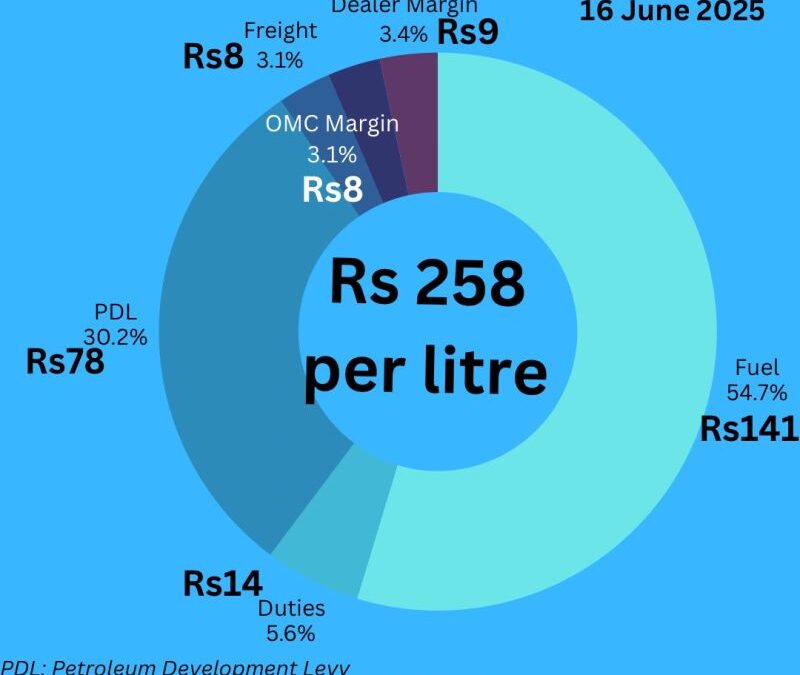
According to the latest official breakdown released by the Ministry of Energy, here is how the petrol price is composed:
| Component | Amount (Rs/Litre) | Percentage |
|---|---|---|
| Ex-Refinery Price / Import Cost | Rs 252.78 | 64.3% |
| Petroleum Levy (PDL) | Rs 60.00 | 15.3% |
| General Sales Tax (GST) 18% | Rs 45.50 | 11.6% |
| Federal Excise Duty (FED) | Rs 9.00 | 2.3% |
| Customs Duty | Rs 6.50 | 1.7% |
| Inland Freight Equalization Margin | Rs 2.00 | 0.5% |
| Climate Support Levy | Rs 2.50 | 0.6% |
| Oil Marketing Company Margin | Rs 7.87 | 2.0% |
| Petrol Pump Dealer Commission | Rs 8.64 | 2.2% |
| Total Retail Price | Rs 393.35 | 100% |
Breaking Down the Major Tax Components
1. Petroleum Development Levy (PDL)
The Petroleum Development Levy, commonly referred to as PDL, is the largest single tax component in petrol pricing. This levy was introduced to generate revenue for the development of Pakistan’s petroleum sector and to reduce the government’s burden on fuel subsidies. The rate is set by the Federal Cabinet and can be adjusted based on fiscal requirements and global oil price movements.
Currently, the PDL on petrol stands at approximately Rs 60 per litre, making it one of the most significant contributors to the overall tax burden on fuel. The government has used PDL as a tool to modulate pump prices while maintaining revenue collection, increasing it when oil prices fall and reducing it when prices spike.
2. General Sales Tax (GST)
Petrol attracts an 18% General Sales Tax, which is applied to the cumulative value of the fuel plus other duties and margins. This makes GST a ad valorem tax that scales with the overall price, meaning it increases whenever the base price of petrol rises. The GST collected goes into the federal consolidated fund and is used for general government expenditure.
The 18% rate was increased from the previous 17% in February 2023 as part of the government’s fiscal consolidation efforts. This single percentage point increase adds several rupees to the price per litre and contributes significantly to government revenue.
3. Federal Excise Duty (FED)
Federal Excise Duty is another indirect tax levied on petrol as an inelastic good. The current FED rate on petrol is approximately Rs 9 per litre. This duty is justified by the government as a measure to discourage excessive fuel consumption, promote conservation, and generate revenue for public services.
FED rates can be revised during annual federal budgets, and historically, each budget has seen increases in excise duties on petroleum products. The duty is considered a sin tax in economic terms, targeting the consumption of goods that have negative externalities including environmental pollution.
4. Customs Duty
Customs duty on petrol is levied when refined fuel is imported into Pakistan. Since domestic refining capacity is limited, a significant portion of Pakistan’s petrol requirements are met through imports, making customs duty a consistent component of the price structure. The current customs duty adds approximately Rs 6.50 to the price per litre.
This duty serves a dual purpose: protecting domestic refineries from foreign competition and generating revenue for the government. The rate is influenced by trade policy decisions and the government’s stance on import substitution.
5. Climate Support Levy (CSL)
The Climate Support Levy is a relatively new addition to Pakistan’s petrol pricing structure, introduced as part of the country’s commitment to environmental sustainability and climate change mitigation. Currently set at Rs 2.50 per litre, this levy funds climate adaptation and environmental protection initiatives.
Pakistan, despite being a minimal contributor to global carbon emissions, faces significant climate change impacts including floods, heatwaves, and water scarcity. The CSL represents a small but growing recognition that fuel consumption has environmental costs that should be factored into pricing.
Distribution and Logistics Costs
Inland Freight Equalization Margin (IFEM)
The Inland Freight Equalization Margin ensures that petrol prices remain roughly uniform across Pakistan regardless of the distance from refineries or import terminals. Pakistan has 22 petroleum storage depots strategically located across the country, and IFEM compensates for the varying transportation costs to reach different regions.
Currently, IFEM adds approximately Rs 2 per litre to the petrol price. This component has been subject to adjustments in recent months, with the government raising it by Rs 3.15 per litre in April 2026 to account for increased transportation costs. The adjustment helps maintain price uniformity while ensuring oil marketing companies can profitably distribute fuel to all parts of the country.
Oil Marketing Company (OMC) Margin
Oil marketing companies such as Pakistan State Oil (PSO), Shell, and Total PARCO earn a margin for their role in importing, storing, and distributing petroleum products. The current OMC margin stands at approximately Rs 7.87 per litre. This margin covers operating costs, storage facilities, and provides a reasonable profit for these companies.
OMC margins are reviewed periodically by OGRA to ensure they remain fair while allowing companies to maintain profitable operations. Excessive margins can lead to higher pump prices, while insufficient margins might discourage investment in fuel distribution infrastructure.
Petrol Pump Dealer Commission
Retail dealers who operate petrol pumps earn a commission on every litre of fuel they sell. Currently set at Rs 8.64 per litre, this commission is their primary source of income from fuel sales. Dealers must maintain infrastructure, provide customer service, and ensure fuel quality standards at their outlets.
The dealer commission has seen gradual increases over the years to keep pace with inflation and operational costs. However, pump owners often complain that the commission does not adequately cover their expenses, particularly in areas with lower sales volumes.
How This Compares Globally
Pakistan’s petrol taxation falls somewhere in the middle range compared to other countries. While some nations have higher fuel taxes (European countries often tax petrol heavily), many developing economies have lower tax rates. The country’s tax structure prioritizes revenue generation over fuel conservation, which reflects its fiscal needs as a developing economy.
When compared to neighboring India, Pakistan’s petrol prices include more separate tax components, though the overall tax burden is comparable. Both countries use fuel taxation as a significant source of revenue, with petrol taxes contributing substantially to federal budgets.
Why Tax Rates Change
The government adjusts petrol tax rates for several reasons. During periods of high global oil prices, authorities may reduce taxes to shield consumers from excessive pump price increases. Conversely, when oil prices fall, the government may raise taxes to maintain revenue levels and avoid windfall gains for fuel retailers.
Fiscal requirements also drive tax adjustments. The federal budget presented each year typically includes revisions to petroleum duties and levies based on the government’s revenue targets. Additionally, international obligations and trade agreements can influence customs duty rates on fuel imports.
Impact on Consumers and the Economy
High petrol taxes have far-reaching effects on the economy. Since petrol is an essential input for transportation, higher fuel prices translate into increased costs for goods and services across all sectors. This phenomenon, known as cost-push inflation, affects everything from food prices to manufacturing costs.
For individual consumers, petrol taxes represent a significant portion of household expenditure, particularly for those who depend heavily on private vehicles for commuting. The regressive nature of fuel taxation means it disproportionately affects lower-income households that spend a larger share of their income on transportation.
Future Outlook
The government faces a challenging balancing act between maintaining fuel tax revenues and keeping pump prices affordable for consumers. As Pakistan seeks to meet IMF fiscal targets, petroleum taxation will likely remain a key revenue tool. However, there is growing recognition that sustained high fuel prices hurt economic growth and burden ordinary citizens.
Potential future changes include restructuring the tax mix by reducing fixed levies in favor of percentage-based taxes, which would create more predictable pricing. There may also be increased focus on using fuel tax revenues for environmental purposes, including investment in electric vehicles and public transportation infrastructure.
Understanding how petrol tax is calculated helps consumers appreciate the complex factors that determine pump prices. While global oil markets set the base price, government policy through various taxes and levies ultimately determines what you pay at the fuel station. Being informed about these components provides clarity in understanding why petrol prices change and how they affect the broader economy.