Pakistan’s fuel levy crisis: how IMF demands turned a Rs80 tax into a Rs134-per-litre burden on the poor
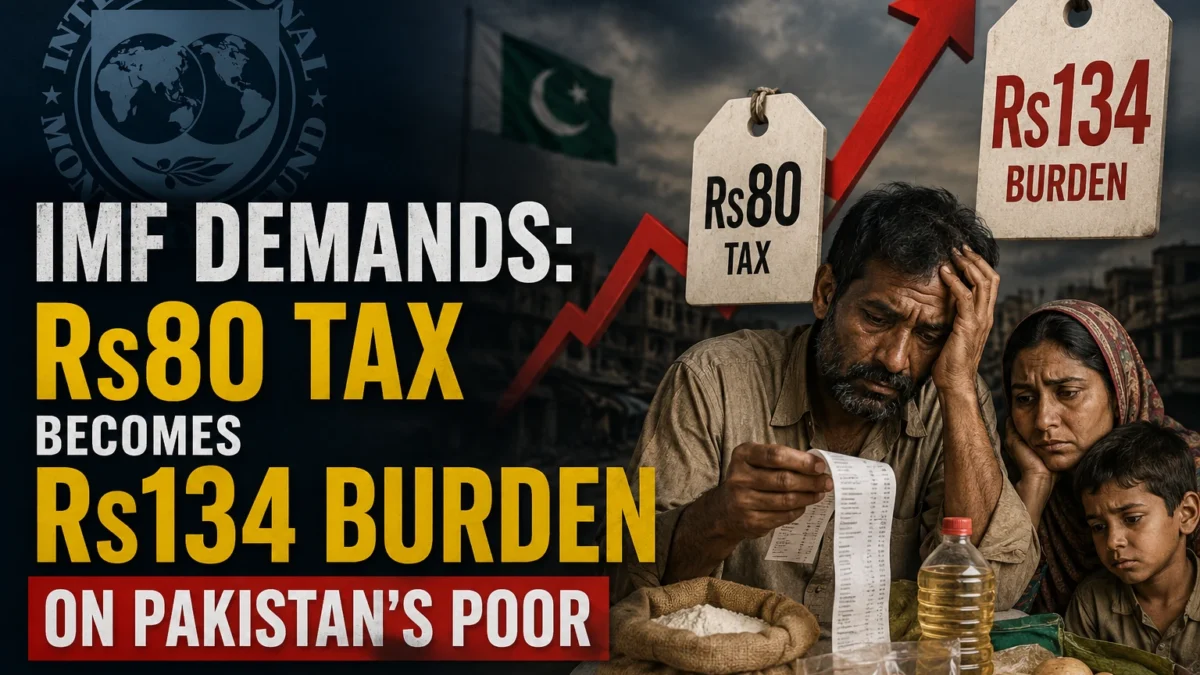
With petrol at Rs393–415 a litre and the petroleum levy now at a record Rs107, Pakistan’s consumers are absorbing a fiscal adjustment that the IMF refuses to relax — even in wartime. We explain every charge, every deadline, and who pays the price.
per litre
IMF target: Rs80/litre on petrol and diesel
Rs53/litre more still owed on one fuel
Carbon levy doubles to Rs5 on 1 July
Illustration: PakistanPetrolPrices.com · Sources: OGRA, Petroleum Division, IMF Staff Reports
Pakistan’s fuel prices are no longer primarily driven by the global oil market. They are driven by a spreadsheet in Washington. In April and May 2026, international petroleum benchmarks remained broadly stable — yet petrol at the pump surged by Rs27 per litre in a single fortnightly notification, powered entirely by a domestic tax increase. The culprit, or depending on your vantage point, the instrument of fiscal discipline, is the petroleum levy: now at a record Rs107.38 per litre on petrol, with more still demanded by Pakistan’s IMF creditors.
To understand how Pakistan arrived here, you need to understand two overlapping IMF arrangements, three types of fuel levy, a captive power gas charge, and the politics of a government that has now imposed, reversed, and re-imposed fuel taxes multiple times in the space of weeks — while insisting each move was unavoidable.
Two programmes, one fuel bill
Pakistan is operating under a 37-month Extended Fund Facility (EFF), approved in September 2024, providing $7 billion in balance-of-payments support. Alongside it runs a 28-month Resilience and Sustainability Facility (RSF), approved in May 2025, adding $1.4 billion earmarked for climate resilience. Both carry conditionalities. Both show up at the petrol pump.
The IMF completed its second EFF review and first RSF review in late 2025, unlocking around $1.2 billion — approximately $1 billion for balance of payments and $200 million in budget support. The third EFF review, covering July to December 2025, cleared in early May 2026. Pakistan met all quantitative performance criteria at end-December 2025, though the Federal Board of Revenue, which missed several indicative targets, remained the weakest link in the programme’s architecture. To offset that shortfall, the government reached for the most reliable instrument available: the petroleum levy.
The petroleum levy: anatomy of a record
The petroleum levy is a federal excise charged at the ex-depot stage. Unlike general sales tax, it does not fall within the National Finance Commission award, meaning the federal government retains 100% of the revenue. This makes it, from an IMF perspective, one of the cleanest and most controllable fiscal instruments in Pakistan’s toolkit.
Its recent trajectory has been extraordinary even by the standards of Pakistan’s volatile energy pricing:
-
Jul 2025Government implements Rs77/litre petroleum levy on petrol, diesel and furnace oil via the Finance Bill 2025-26. Annual collection target set at Rs1.468 trillion.
-
Mar 2026Middle East conflict — including closure of the Strait of Hormuz — triggers a global supply shock. Pakistan raises fuel prices by Rs55/litre within a week. Petrol briefly exceeds Rs450/litre.
-
2 Apr 2026Petroleum Minister Ali Pervaiz Malik and Finance Minister Muhammad Aurangzeb announce hikes of 43% on petrol, 55% on diesel. The petroleum levy on petrol reaches an all-time high of Rs160/litre.
-
3 Apr 2026PM Shehbaz Sharif announces an Rs80/litre reduction in the petroleum levy — presented publicly as relief. Petrol falls to Rs378. What went unannounced: the government had itself set the levy at Rs161; it was now reducing its own emergency surcharge.
-
24 Apr 2026The levy is raised again to Rs107.38/litre on petrol — up Rs26.77. Petrol rises to Rs393.35, diesel to Rs380.2. The IMF had demanded Rs80/litre on both petrol and diesel; instead of applying Rs80 to diesel, the government loaded more onto petrol consumers.
-
May 2026Petrol confirmed at Rs393–415/litre in the latest OGRA notification. Petroleum levy on petrol remains at approximately Rs103.50–107/litre. A further Rs53/litre is still owed to the IMF on one of the two main fuels.
-
1 Jul 2026The Climate Support Levy doubles from Rs2.5 to Rs5/litre on petrol, diesel and furnace oil. This step was legislated as a structural benchmark under the RSF before June 30, 2025, and cannot be reversed without breaching programme conditions.
“The entire increase came from one place — the federal government tax. In 76 years, no government has fixed the tax base. Every time the shortfall hits, it is the electricity bill, the gas bill, the petrol price that goes up — never a wealth tax, never a property tax on the elite.”
— PakWheels analysis, April 2026What you pay per litre: the full breakdown
| Component | Petrol (Rs/litre) | Diesel (Rs/litre) | Direction |
|---|---|---|---|
| Petroleum Levy | 107.38 | 0 (deferred) | ↑ All-time high |
| Customs Duty | 23.72 | 33.00 | → Unchanged |
| Climate Support Levy | 2.50 | 2.50 | ↑ Doubles 1 Jul 2026 |
| Freight & OMC margin | ~17.14 | ~17.14 | → Stable |
| Dealer commission | ~7.00 | ~7.00 | → Stable |
| Total tax & charges | ~134 | ~36 | ↑ ~32% of pump price |
| Pump price (May 2026) | 393–415 | 380+ | ↑ Near record |
Diesel currently carries zero petroleum levy — a deliberate government choice to protect freight transport and agriculture. But the IMF has demanded Rs80/litre on diesel too. Sources indicate the government must decide imminently whether the remaining Rs53/litre IMF obligation falls on diesel users, petrol users, or both. Whichever direction it takes, prices at the pump will rise again.
The carbon levy: Pakistan’s climate tax
The second major levy is the Climate Support Levy (CSL), introduced as a structural benchmark under the RSF programme. Currently Rs2.50/litre on petrol, diesel and furnace oil, it doubles to Rs5/litre on 1 July 2026 as the next scheduled escalation. The levy was legislated through the Finance Bill 2025-26 before June 30, 2025 — it is not optional.
Revenue from the CSL is earmarked, at least in principle, for climate resilience: natural disaster preparedness, water resource efficiency, and the other four pillars of Pakistan’s RSF obligations. In practice, given Pakistan’s fiscal pressures, the distinction between earmarked and general revenue can blur in budget execution.
The captive power gas levy: industry in the crossfire
Beyond liquid fuels, the IMF has reshaped gas pricing for Pakistan’s industrial sector. The Captive Power Levy (CPL), introduced on 1 February 2025, sets gas prices for captive power plants — factories and mills that generate their own electricity — at the industrial grid equivalent plus a surcharge. That surcharge started at 5% and rises by 5 percentage points every six months, reaching 20% by August 2026.
In late April, the IMF allowed one concession: the levy will now be calculated using a weighted average of peak and off-peak B3 industrial electricity tariffs rather than the peak rate alone. This is expected to reduce the levy from Rs1,303/mmBtu to approximately Rs522/mmBtu — a cut of up to 60% for some consumers in some months.
The policy creates a paradox: industries face rising costs whether they use grid electricity or gas-based captive generation. Many are turning to rooftop solar — which in turn has prompted policymakers to begin considering new regulatory barriers to solar adoption, a development that IMF officials are watching with concern.
The political arithmetic: who absorbs the cost
By the end of the first nine months of fiscal year 2025-26, the government had collected more than Rs1.2 trillion in petroleum levy — 82% of the full-year target of Rs1.468 trillion. Despite being ahead of schedule, the government raised the levy further in April and May, under continued IMF pressure to meet revenue commitments.
When global oil prices spiked following the Middle East conflict, PM Shehbaz Sharif attempted to negotiate some levy relief. The IMF said no. Officials confirmed the Fund views the petroleum levy as a non-negotiable anchor within the programme — and refused to relax conditions even during wartime. Government functionaries have been unable to convince the IMF to adjust punitive conditions, a fact that Petroleum Minister Malik acknowledged obliquely in his April statement attributing the hike to “agreements with global partners.”
“Pakistan appears to face the weakest fuel affordability among South Asian markets — measuring the proportion of per-capita monthly income needed to fill a tank.”
— PakWheels analysis citing World Bank income data, April 2026For motorcycle owners — Pakistan’s largest fuel user demographic — the Rs107 levy means a 10-litre fill carries approximately Rs1,070 in tax alone. Diesel’s zero levy provides some buffer for freight and food costs, but that relief is conditional on the government continuing to absorb the IMF’s Rs80/litre demand through petrol users instead.
What is still coming: the levy pipeline
| Obligation | Deadline | Status |
|---|---|---|
| Climate Support Levy: Rs2.5 → Rs5/litre | 1 July 2026 | ⚡ Legislated · Confirmed |
| Diesel petroleum levy at Rs80/litre (IMF demand) | Imminent decision | ⚠ Under negotiation |
| Captive power gas levy reaches 20% | Aug 2026 (may be Jul) | ⚡ Confirmed escalation |
| FY2026-27 budget passed in line with IMF agreement | 30 June 2026 | 📋 Parliamentary commitment |
| Electricity & gas progressive tariff adjustments | Ongoing quarterly | 📋 Committed |
| SEZ/STZA fiscal incentive phase-out legislation | June 2027 | ✔ Committed |
Bottom line
Pakistan’s fuel pricing crisis in 2026 is, at its core, a story about fiscal architecture — about what happens when a government that cannot broaden its tax base beyond a narrow set of formal-sector contributors turns to the most visible, least resistible lever available: the petrol pump. The IMF’s refusal to allow levy relief, even as fuel prices hit historic highs and regional conflict disrupted global supply chains, reveals how firmly Pakistan’s fiscal decisions are now constrained by its programme commitments.
Relief will not come from lower global oil prices alone. It would require either a levy reduction — which the IMF opposes — or a structural expansion of the tax base beyond petroleum. Until that structural shift happens, every litre of petrol pumped in Pakistan carries within it the cost of a fiscal bargain struck with conditions that favour revenue certainty over consumer welfare.