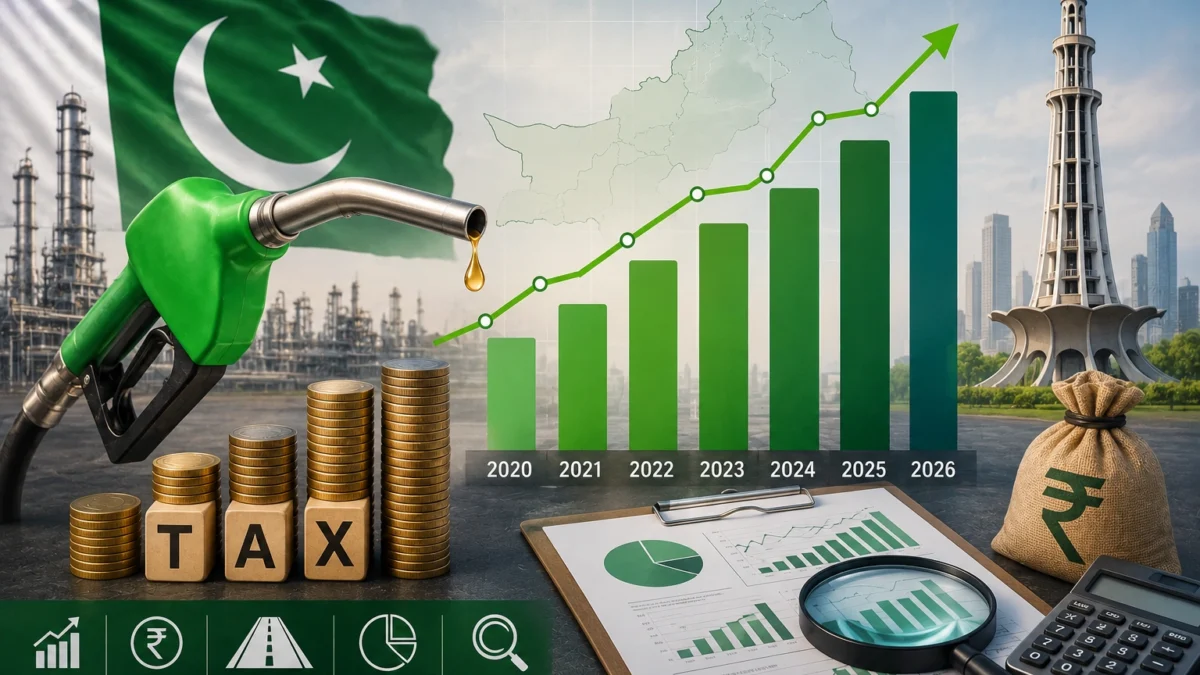
Petroleum Levy Tax History
in Pakistan — 2020 to 2026
How Pakistan’s most powerful fuel tax went from Rs. 0/litre to Rs. 107+/litre in six years — the full data, trends & analysis
The Petroleum Development Levy (PDL) — now formally renamed under the Petroleum Products (Petroleum Levy) and Climate Support Levy Ordinance, 1961 — is the single most powerful tax tool in Pakistan’s fuel pricing arsenal. Unlike GST, it is non-divisible: every rupee collected goes directly to the federal government and is never shared with the provinces under the National Finance Commission (NFC) Award. This makes it the fiscal instrument of first resort whenever Islamabad faces a revenue shortfall.
From 2020 to 2026, the petroleum levy has swung more wildly than any other component of Pakistan’s petrol price formula — dropping to zero under PTI’s populist relief package, then rocketing past Rs. 100/litre under IMF-driven fiscal consolidation. This article traces that full arc: the decisions, the politics, the IMF conditions, and the burden on ordinary Pakistanis.
Petroleum Levy Trend — Petrol (2020–2026)
The chart below plots the approximate petroleum levy rate on petrol (MS-92) at key policy junctures from 2020 through May 2026. The zero-levy period under PTI (Feb–May 2022) and the record hike to Rs. 161 in April 2026 are the two most striking inflection points.
Year-by-Year Timeline — 2020 to 2026
COVID-19 crushed global oil demand in early 2020. Brent crude briefly turned negative in international spot markets (April 2020), and Pakistan’s petrol price hit a multi-decade low of Rs. 74.52/litre in June 2020. The PTI government maintained a modest PDL — around Rs. 10–17/litre — using the windfall from low crude prices to hold consumer costs down while still generating some revenue.
Annual PDL revenue for FY2019-20 was Rs. 294 billion — respectable given the low crude environment, and up from Rs. 206 billion in FY2018-19. The levy was essentially serving as a consumption buffer: keeping prices near historical norms while the government quietly collected per-litre.
As the global economy reopened, crude demand surged. OPEC+ production cuts kept supply tight, and Brent climbed from ~$50/barrel in January 2021 to over $80 by year-end. Pakistan’s petrol price rose from Rs. 107.59 in January 2021 to Rs. 127.30 by December — a 40/litre jump driven mainly by crude costs.
The PDL fluctuated between Rs. 25–30/litre during this period. Annual collection for FY2020-21 hit a record high of Rs. 424 billion — the highest ever at that point — as higher pump prices meant more tax per litre sold plus elevated volumes of consumption. The government was quietly benefiting from the crude recovery.
The Russia-Ukraine war (February 2022) sent Brent crude surging past $130/barrel — the highest since 2008. Global inflation spiked. Facing a political crisis and no-confidence motion, the PTI government made a dramatic move: it zeroed out the petroleum levy on petrol and diesel, while also suspending GST on fuel.
The result was a massive revenue hole. The federal government was losing billions daily subsidising a product priced at international rates. FY2021-22 PDL revenue collapsed to just Rs. 128 billion — a 70% collapse from the Rs. 424 billion collected the year before. The IMF immediately flagged this as a violation of programme conditions and suspended the Extended Fund Facility (EFF).
When the PTI government fell in April 2022 and the PDM coalition took power, they inherited an impossible situation: restore the levy and face public rage, or continue the subsidy and haemorrhage reserves. They chose to restore it — and more.
The PDM government under PM Shehbaz Sharif immediately began raising petroleum prices. On May 26, 2022, petrol jumped from Rs. 149.86 to Rs. 179.86 overnight. Three weeks later it crossed Rs. 200 for the first time in Pakistan’s history. By June 2022, it reached Rs. 233.89/litre. See our petrol price history for the full 2022 timeline.
The PDL was restored in stages — rising from zero to approximately Rs. 30 by mid-2022 and inching toward Rs. 50 by year-end as the government scrambled to satisfy IMF revenue conditions and revive the EFF. The levy on HSD diesel was raised faster, as the IMF was particularly focused on reducing fuel subsidies on the commercial fuel.
2023 was the cruellest year in Pakistan’s fuel history. The rupee lost over 40% of its value against the dollar in a single year. IMF conditions ruled out subsidies. Petrol hit Rs. 323.38/litre in September 2023 — the highest sustained price in the country’s recorded history at that point.
The petroleum levy was raised from Rs. 50 to Rs. 60/litre on both petrol and HSD in the second half of 2023, as the government committed to the IMF to collect Rs. 918 billion in PDL for FY2023-24 — revised upward from the original Rs. 869 billion target. Annual PDL revenue for FY2022-23 had already recovered to Rs. 580 billion.
The constitutional question began to surface: under what legal authority was the government raising the levy beyond Parliament’s set ceiling? The Finance Act 2023 expanded the cap, but the government was already testing the limits of executive pricing authority.
In June 2024, the ECC (Economic Coordination Committee) raised the maximum cap on the petroleum levy to Rs. 90/litre. The Finance Act 2024 formalized a ceiling of Rs. 70/litre but the ECC cap gave operational room to go higher. In practice, the effective levy on petrol settled around Rs. 70–78/litre through most of 2024 as global crude softened and petrol prices fell from the 2023 peak.
Pakistan signed a new 37-month Extended Fund Facility (EFF) with the IMF in July 2024 — a $7 billion programme. The petroleum levy was a central revenue pillar. The FY2024-25 PDL collection target was set at Rs. 1,161 billion — nearly double FY2022-23’s actual collection of Rs. 580 billion. The first 9 months of FY2024-25 already saw Rs. 1.2 trillion collected — on track.
By end-2024, petrol had fallen to Rs. 247.03/litre — a welcome reduction — but the PDL remained elevated. Consumers were paying less for petrol overall, but the levy was maintaining revenue even as crude softened.
Through 2025, petrol hovered between Rs. 252–270/litre. The PDL stayed at approximately Rs. 78/litre on petrol — the pre-crisis “normal.” The FY2025-26 collection target was set at a record Rs. 1,468 billion, with government projections suggesting collections reaching Rs. 1,501 billion by FY2027-28.
The legal framework had now shifted fundamentally: the government no longer needed Parliamentary approval to change the levy rate. A single executive notification — issued by the Ministry of Finance — could move it in any direction, at any time. This power was about to be used dramatically.
The catalyst was geopolitical. On February 28, 2026, US-Israeli military strikes on Iran triggered the closure of the Strait of Hormuz — through which ~20% of global oil transits. Brent crude surged from ~$75 to over $130/barrel within weeks. For Pakistan, already importing 81% of its oil requirements, the shock was severe.
The government’s response was to layer domestic tax increases on top of the international price surge — a pattern critics called “manufactured crisis followed by theatrical relief.” The Rs. 161 levy was set; public outrage was immediate; it was then cut to Rs. 80 as “relief.” But 21 days later, on April 24, the levy was restored to Rs. 107 — a Rs. 26.77/litre increase in a single notification.
By May 9, 2026, with the PDL at Rs. 107+ on petrol and petrol at Rs. 414.78/litre, total taxation on petrol (PDL + customs + climate levy) exceeded Rs. 134/litre. Of every Rs. 414.78 paid at the pump, roughly Rs. 150+ was government tax.
Petroleum Levy Rates at a Glance — 2020 to May 2026
The table below captures the approximate PDL rate on petrol (MS-92) at key policy milestones. Due to fortnightly adjustments, rates may have varied slightly within each period. Cross-reference with OGRA official notifications.
| Period | PDL on Petrol (Rs/L) | PDL on HSD (Rs/L) | Change | Govt / Context |
|---|---|---|---|---|
| Jan–Jun 2020 | 10–17 | ~17 | Stable | PTI COVID low prices |
| Jul 2020–Dec 2020 | ~17 | ~17 | Stable | PTI Gradual recovery |
| Jan–Jun 2021 | 25–30 | ~25 | ▲ Raised | PTI Crude recovery |
| Jul–Dec 2021 | ~30 | ~30 | Stable | PTI OPEC+ tightening |
| Jan–Feb 28, 2022 | ~30 | ~30 | Pre-relief | PTI Russia-Ukraine shock |
| Feb 28–May 25, 2022 | 0 | 0 | ▼ ZERO | PTI Relief package — IMF halted |
| Jun–Sep 2022 | 30–40 | ~25 | ▲ Restored | PDM IMF revival |
| Oct–Dec 2022 | ~50 | ~40 | ▲ Raised | PDM Revenue pressure |
| Jan–Jun 2023 | 50 | 50 | Stable | PDM Peak petrol era |
| Jul–Dec 2023 | 60 | 60 | ▲ +10 | Caretaker IMF Rs.918B target |
| Jan–Jun 2024 | 60–70 | ~55 | ▲ Creeping | PML-N EFF FY24 conditions |
| Jul–Dec 2024 | 70–78 | ~65 | ▲ Cap raised to 90 | PML-N $7B IMF EFF signed |
| Jan–Mar 2026 | 78 | ~75 | Pre-crisis stable | PML-N Hormuz Crisis building |
| Apr 3, 2026 | 161 | 160.61 | ▲ ALL-TIME HIGH | PML-N Petrol hit Rs.459 — reversed in 24h |
| Apr 4, 2026 | 80 | ~75 | ▼ PM “relief” | PML-N Petrol → Rs.378 |
| Apr 24, 2026 | 107.38 | ~95 | ▲ +26.77 vs Apr 4 | PML-N “Relief” expired |
| May 9, 2026 (Latest) | ~107 | ~95 | Current Rate | PML-N Petrol Rs.414.78 |
Annual PDL Revenue Collection — FY2019 to FY2026
The collapse in FY2021-22 (when PTI zeroed the levy) and the explosive recovery since then tell a stark fiscal story. By FY2025-26, the government expects to collect more than 7× what it collected in the zero-levy year.
Key PDL Statistics — 2020 vs 2026
The IMF Connection — Why the Levy Keeps Rising
The petroleum levy’s trajectory since 2022 cannot be understood without the IMF. Pakistan has been under one IMF programme or another since 2019, and the PDL has consistently been a central revenue pillar demanded by the Fund. Understanding this helps explain why relief is always temporary — and why the levy always comes back higher. For deeper context, see our petrol price calculation guide.
Why the IMF Demands High Petroleum Levy
The petroleum levy is the federal government’s only non-shareable fuel tax — making it ideal for meeting federal fiscal targets without provincial complications.
- PDL is not shared with provinces under NFC — 100% stays federal
- Unlike GST, it doesn’t require Provincial Finance Commission calculations
- Easy to adjust via executive notification — no parliamentary delay
- IMF EFF (2019, 2023, 2024) all included explicit PDL revenue targets
- FY2023-24 target: Rs.918B — revised upward mid-year from Rs.869B
- FY2025-26 target: Rs.1,468B — a 26% jump over prior year
- Finance Act 2025 removed the statutory maximum — levy now uncapped
- Government projects Rs.1,501B by FY2027-28
What This Means for Consumers
The levy increase from Rs. 10/litre in 2020 to Rs. 107/litre in 2026 — a 970% rise — is the single largest driver of Pakistan’s pump price inflation over this period, outpacing even the effect of international crude oil price changes. Consider:
For public transport operators and freight companies — which run on diesel — the cumulative levy increases translate directly into fare hikes and goods price inflation felt by every Pakistani household. This is why petrol prices are one of the most tracked economic indicators in the country. Read our full May 2026 petrol price update and the complete petrol price history for the full picture.
A petition filed in the Federal Constitutional Court has demanded fuel price caps at Rs. 200/litre — a reflection of how far current prices have moved from what ordinary citizens can bear.
Key Trends & Patterns
Six years of petroleum levy data reveal four clear structural patterns: