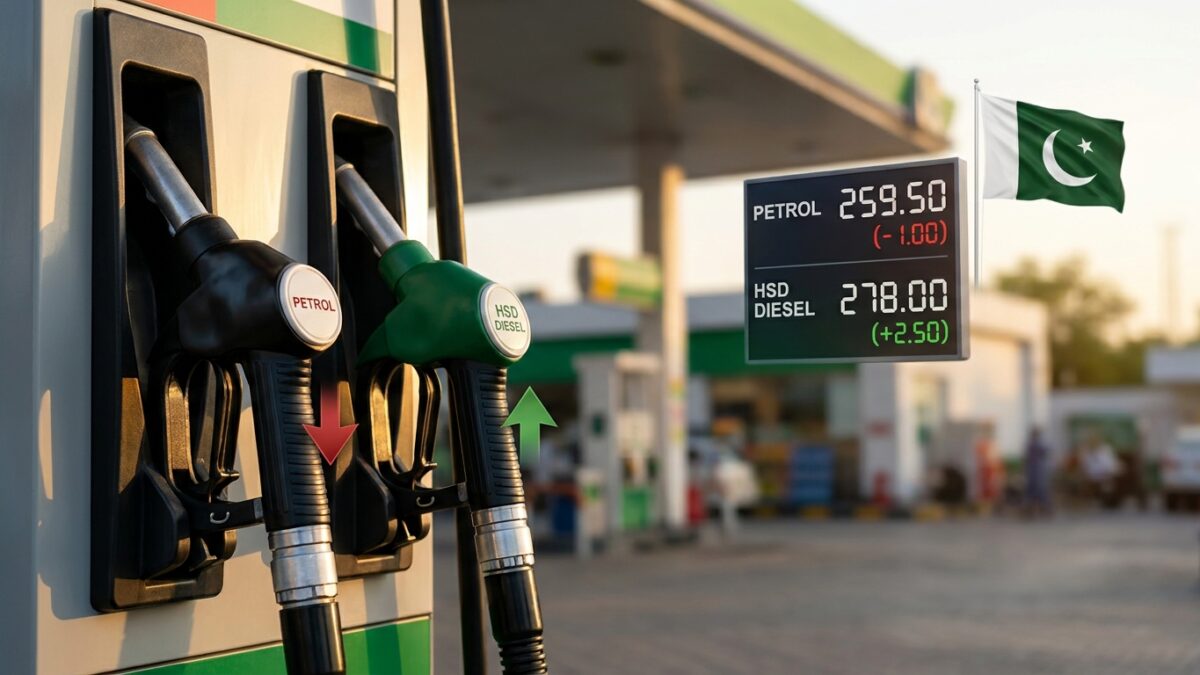
In an effort to contain rising inflation and provide relief to the general public, the federal government has adjusted the petroleum levy on major fuel products with effect from Saturday. The petroleum levy on petrol (MS-92) has been slashed by Rs 40.49 per litre, bringing it down from Rs 106.74 to Rs 66.25 per litre. At the same time, the levy on High-Speed Diesel (HSD) has been raised by Rs 19.71 per litre, rising from Rs 53.26 to Rs 72.97 per litre. The decision reflects the government’s attempt to balance consumer relief at the pump for private motorists with revenue protection on commercial diesel consumption, where most cross-border and freight movement sits.
What the new levy structure looks like
The new per-litre petroleum levy rates, effective from Saturday:
| Product | Old Levy (Rs/litre) | New Levy (Rs/litre) | Change |
|---|---|---|---|
| Petrol (MS-92) | 106.74 | 66.25 | ▼ Rs 40.49 |
| High-Speed Diesel (HSD) | 53.26 | 72.97 | ▲ Rs 19.71 |
The levy is one of three layers that determine the consumer-facing petrol pump price. The full breakdown is on our complete breakdown of what you pay at the pump. The other two layers are the ex-refinery / import price (set bi-weekly by OGRA) and the dealer margin plus GST on the levy itself.
What this means for the pump price
The headline pump price is the ex-refinery base plus the petroleum levy plus the dealer margin plus GST on the levy. A Rs 40.49 reduction in the levy translates directly into roughly Rs 45-47 reduction in the headline pump price, once the GST cascading on the lower levy is factored in. The exact final reduction will be visible in the OGRA notification accompanying the levy change.
For context: the headline petrol rate currently sits at Rs 377.81 per litre (effective June 13, 2026), following the post-Eid relief cycle. With the levy cut alone, the new rate should drop to approximately Rs 332-335 per litre. If the OGRA ex-refinery adjustment moves at the same time — and reports suggest the PM’s announcement of a “massive reduction” effective June 20 covers both the levy and the international crude component — the headline rate could fall into the Rs 320-325 range.
Why the diesel levy is going up
Commercial diesel consumption sits at the centre of three politically difficult categories: freight and logistics, public transport, and agriculture (tubewells, threshers, harvesters). All three are highly diesel-dependent, and all three have politically sensitive consumer bases — truck and bus operators, smallholder farmers, and the urban working class that depends on bus and wagon services.
By cutting the petrol levy while raising the diesel levy, the government is delivering visible consumer relief at the petrol pump — where the bulk of media coverage and middle-class voter attention focuses — while recouping some revenue from diesel-heavy commercial and agricultural users who have less ability to switch to substitutes.
What the asymmetry signals about fiscal space
The IMF programme for FY26-27 sets a petroleum-levy revenue target of Rs 1.727 trillion — an increase of Rs 259 billion over FY26. Hitting that target requires the average annual levy per litre to remain elevated. A unilateral Rs 40.49 cut on petrol would have produced a substantial revenue shortfall, on the order of Rs 230-260 billion if applied for the full second half of FY27.
By raising the HSD levy by Rs 19.71 at the same time, the government recovers approximately Rs 130-150 billion over the second half, partially offsetting the petrol-levy cut. The net revenue impact is in the range of Rs 80-130 billion foregone — still significant, but materially less than the unilateral cut would have produced. The IMF programme likely treats this as a one-off Eid relief measure rather than a structural change to the levy schedule.
The wider context: relief announcement from June 19
This levy change is the formal implementation of the “massive reduction” Prime Minister Shehbaz Sharif announced on June 19, 2026, framed as an Eid ul Adha gift. The PM’s announcement covered both the levy adjustment (now formalised in this notification) and the OGRA ex-refinery adjustment that will accompany it. The combination produces the headline rate reduction expected for June 20.
The full breakdown of the June 19 announcement is in our June 19 PM petrol reduction article, and the live June 2026 petrol price page is updated with the new rates as soon as the OGRA notification is issued.
What to expect on Saturday
The new rates will be binding across all petrol pumps in Pakistan from Saturday. Once the full OGRA notification is issued, the live petrol price page will reflect the new national rate, and the city-specific pages for Karachi, Lahore, Islamabad, and other cities will be updated at the same time.
Historical context: the petroleum levy in 2025-2026
The petroleum levy has moved through several structural regimes in the past 18 months:
- FY25 average: Rs 60-65 per litre on petrol; Rs 50-55 on HSD, with frequent end-of-cycle resets
- FY26 peak (April 2026, wartime): Rs 106.74 on petrol, Rs 53.26 on HSD — the rates before this notification
- FY27 (this notification): Rs 66.25 on petrol, Rs 72.97 on HSD
The full history of levy rates is on our petroleum levy history and trends analysis, and the broader petrol price history is in our petrol price history archive.
Frequently asked questions
Sources: Federal government notification on petroleum levy adjustment (June 20, 2026); Prime Minister’s national address, June 19, 2026; Tribune, Dawn,Business Recorder, Pakistan Today, ARY News, GNN News; OGRA notifications; Pakistan Petroleum Division. The full pump-price effect will be confirmed by the OGRA notification accompanying the levy change, and this page will be updated with the final figures as soon as the notification is released.