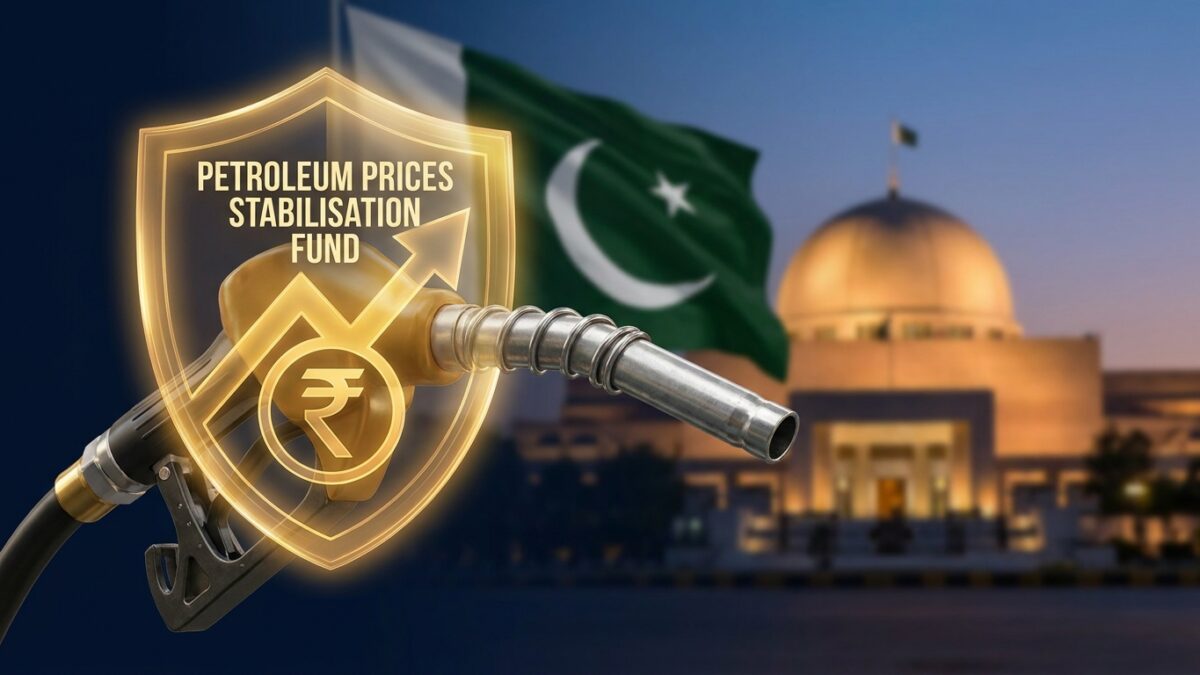
The federal government, through the Economic Coordination Committee (ECC) of the Cabinet, has formally established the Petroleum Prices Stabilisation Fund (PPSF) — a dedicated financial mechanism designed to insulate Pakistani consumers from the volatility of global crude oil prices. The fund is being seeded with Rs 27.1 billion from the PM Austerity Fund, and the Oil and Gas Regulatory Authority (OGRA) has been designated as the administering body. The PPSF will operate as a revolving fund: when global oil prices spike, money flows out to keep domestic prices stable; when prices fall, excess revenue is recouped. For the average Pakistani consumer, the fund means smaller and less frequent petrol and diesel price shocks — and for the broader economy, it means reduced inflation volatility tied to energy.
What problem the PPSF solves
Pakistan’s fuel pricing system has historically been one of the most politically sensitive in the country. Each bi-weekly OGRA price notification triggers public debate, parliamentary criticism, and consumer frustration when prices rise. The system has produced three structural problems:
- Pass-through volatility: Every $10/barrel change in international crude translates directly into Rs 8-12 per litre change at the pump
- Political pressure on pricing: Frequent ad-hoc subsidies and freezes have undermined fiscal sustainability
- Inflation transmission: Fuel price spikes feed directly into transport, food, and manufacturing costs within 4-6 weeks
The PPSF addresses these by creating a buffer fund that smooths the pass-through. When global prices rise sharply, the fund pays out to keep domestic prices flat or only partially up; when prices fall, the fund recovers the cost differential. Over time, this reduces both the magnitude and frequency of consumer-facing price changes.
How the fund works
The PPSF is a classic commodity stabilisation fund. The mechanics:
OGRA continues its bi-weekly price review, computing the new “true” ex-refinery price based on international crude, exchange rate, and dealer margins.
If the “true” price would result in a pump-price change of more than Rs 5/litre (up or down), the PPSF intervenes to absorb the difference beyond Rs 5.
The Ministry of Energy notifies the actual pump-price change, which is the “true” change capped at ±Rs 5/litre when the PPSF intervenes.
If the fund paid out (price rose but consumer paid less), the fund balance decreases. If the fund collected (price fell but consumer paid more), the balance increases.
When the fund balance falls below a defined floor (e.g., 20% of initial seed), the ECC is approached for a top-up allocation from the federal budget or the PM Austerity Fund.
Where the initial funding comes from
The Rs 27.1 billion seed was sourced from the PM Austerity Fund, a separate pool that the Prime Minister’s Office controls for emergency economic measures. The Austerity Fund is replenished through:
- Voluntary federal ministry budget cuts (typically 5-10% per ministry)
- Specific allocations in supplementary budgets
- Special levies or windfall revenue
Diverting the Austerity Fund to the PPSF represents the government’s priority signal that consumer fuel-price stability is a top-tier fiscal priority.
What the fund covers
The PPSF is initially structured to cover the major petroleum products:
| Product | Coverage | Max cushion |
|---|---|---|
| Petrol (MS-92) | Primary | Rs 5/litre per revision |
| High-Speed Diesel (HSD) | Primary | Rs 5/litre per revision |
| Kerosene | Secondary | Rs 3/litre per revision |
| Light Diesel Oil (LDO) | Secondary | Rs 3/litre per revision |
| LPG (cooking gas) | Not yet covered | — |
PMS and HSD account for the bulk of consumer fuel consumption in Pakistan, so covering these first makes sense. Expansion to kerosene and LDO is planned for phase 2.
How much oil-price shock can Rs 27.1B absorb
The arithmetic of the cushion:
| Shock type | Pump-price impact | PPSF cost |
|---|---|---|
| $5/barrel crude increase | ~Rs 4/litre | Within Rs 5 cap — no PPSF needed |
| $10/barrel crude increase | ~Rs 8/litre | Rs 3/litre cushion × ~700,000 tonnes/month = ~Rs 2.5 billion/month |
| $20/barrel crude increase | ~Rs 16/litre | Rs 11/litre cushion (above Rs 5 cap) × 700,000 tonnes/month = ~Rs 9 billion/month |
| $30/barrel crude increase | ~Rs 24/litre | Rs 19/litre cushion × 700,000 tonnes/month = ~Rs 15 billion/month |
At Rs 27.1 billion initial seed, the fund can absorb approximately:
- 3 months of a $20/barrel shock
- 2 months of a $30/barrel shock
- 10 months of a $10/barrel shock
For a sustained crisis (e.g., 6+ months of $20+/barrel elevation), the fund would need replenishment. The ECC top-up mechanism is designed for this scenario.
Historical context: previous oil-price interventions
Pakistan has used multiple mechanisms to manage fuel-price volatility over the years:
| Mechanism | Period | Outcome |
|---|---|---|
| Direct subsidies (pre-2022) | Until 2022 | Costly, unsustainable, IMF-program violation |
| Petroleum levy reduction | 2022-2024 | Revenue foregone, partial relief |
| Targeted subsidies (motorcyclists, transport, farmers) | 2024-2026 | Narrow coverage, leakages |
| PMSF (new) | From 2026 | Market-conformant smoothing, IMF-aligned |
The PPSF is the first mechanism that combines market-based pricing with a buffer fund — rather than directly suppressing prices through subsidies or levy cuts. This is consistent with the IMF programme’s guidance on energy-pricing reforms.
How the PPSF compares to similar international mechanisms
Several countries operate similar stabilisation funds:
| Country | Fund name | Mechanism | Size relative to consumption |
|---|---|---|---|
| India | Price Stabilisation Fund (PSF) | Buffer for petroleum and ATF | ~0.5-1% of annual fuel imports |
| Indonesia | Oil Price Stabilisation Fund (BOPS) | Cushion during oil shocks | ~1% of fuel imports |
| Thailand | Oil Fuel Fund | Subsidy mechanism | Variable |
| Malaysia | Fuel subsidy rationalisation | Direct subsidy, being phased out | Larger |
| Pakistan | PPSF (new) | Cushion mechanism | ~0.3-0.5% of fuel imports initially |
Pakistan’s PPSF is smaller in relative size than India’s and Indonesia’s, but the design is similar. As the fund grows through replenishment, the relative coverage will expand.
How the PPSF interacts with the petroleum levy
The petroleum levy is the federal government’s primary revenue tool on fuel — currently around Rs 66/litre on petrol (after the recent Rs 40 cut from Rs 106) and Rs 73/litre on HSD. The levy flows into federal revenue and supports the IMF programme’s revenue floor target.
The PPSF interacts with the levy in a specific way:
- When international prices fall: PPSF collects (consumer pays above the “true” price), strengthening its balance
- When international prices rise: PPSF pays out (consumer pays below the “true” price), reducing its balance
- Petroleum levy is unchanged: The levy continues to be collected at the notified rate, regardless of PPSF intervention
This separation is important — the PPSF is a smoothing tool, not a subsidy tool. The federal revenue stream (petroleum levy) is not affected by the PPSF.
What this means for consumers
The expected consumer experience:
- Smaller price swings: Pump-price changes typically capped at Rs 5/litre per bi-weekly revision
- More predictability: Easier household and business budgeting
- Less political-cycle volatility: Reduced incentive for ad-hoc price freezes around elections or sensitive periods
- Smoother inflation: Reduced pass-through of fuel-price volatility into CPI
For a household spending Rs 8,000/month on petrol, the PPSF caps the bi-weekly price change to Rs 5/litre — translating to a maximum monthly change of ~Rs 2,000 rather than the Rs 4,000-8,000 swings that have historically occurred.
Risks and limitations
| Risk | Description | Mitigation |
|---|---|---|
| Sustained high crude prices | Depletes the fund quickly; consumer still feels long-term price increase | ECC top-up mechanism; phased consumer absorption |
| Rupee depreciation | Increases the PKR cost of imported oil independently of crude | Separate stabilisation consideration; SBP reserves provide partial buffer |
| Political interference | Pressure to use the fund for election-period freezes beyond intended scope | Strict ECC approval process; parliamentary oversight |
| Fund mismanagement | Corruption or diversion of fund resources | Independent audit; OGRA governance framework |
| Counterproductive market signal | Reduced consumer incentive to reduce consumption during high-price periods | PPSF caps the protection; full price pass-through over time |
How the fund gets replenished
The PPSF can be replenished through:
- Internal accrual: When global prices fall and the PPSF collects the differential, the balance increases
- ECC top-up: From federal budget allocation, typically from the PM Austerity Fund or supplementary grants
- Petroleum levy surplus: If petroleum levy revenue exceeds IMF-program targets, the surplus can be allocated to the PPSF
- External financing: Concessional loans from multilateral institutions (World Bank, ADB) specifically for energy-sector stabilisation
- Public-private partnership: Future option where oil marketing companies contribute to the fund
The first replenishment cycle is expected within 6-12 months of fund inception, depending on global crude price trajectory.
What to watch in the next 6 months
Key signals that will determine whether the PPSF succeeds:
| Signal | What it tells us |
|---|---|
| First PPSF intervention (payout) | The fund has been triggered; the mechanism works |
| OGRA disclosures | Whether the fund’s intervention is visible in the price notification |
| PPSF financial statements | Quarterly balance and replenishment needs |
| ECC top-up requests | How often the fund needs replenishment |
| Consumer response | Whether smaller price swings lead to smoother consumer behaviour |
| IMF review feedback | Whether the IMF views the PPSF as compliant with the programme |
— Ministry of Energy policy note, June 2026
Frequently asked questions
Related coverage on PakistanPetrolPrices.com
For the broader fuel-price dynamics that the PPSF is designed to smooth, our PM’s massive petrol reduction announcement coverage explains the recent policy moves. For how international crude pricing flows into Pakistani pump prices, our complete breakdown of what you pay at the pump is the canonical reference. For the petroleum-levy side of the picture that the PPSF sits alongside, our petroleum levy history 2020-2026 walks through the related framework. And for the live pump prices across cities that the PPSF will now move less dramatically, our June 2026 live petrol price page shows the current state.
Sources: Economic Coordination Committee (ECC) of the Cabinet notification, Ministry of Energy (Petroleum Division), Oil and Gas Regulatory Authority (OGRA), PM Austerity Fund statements, Finance Division press releases, IMF Article IV report (Pakistan), State Bank of Pakistan energy-import data, ARY News, Dawn, Business Recorder, The News International, Express Tribune, Geo News. PPSF structure and rules current as of June 30, 2026; specific intervention thresholds may be revised based on fund performance.